
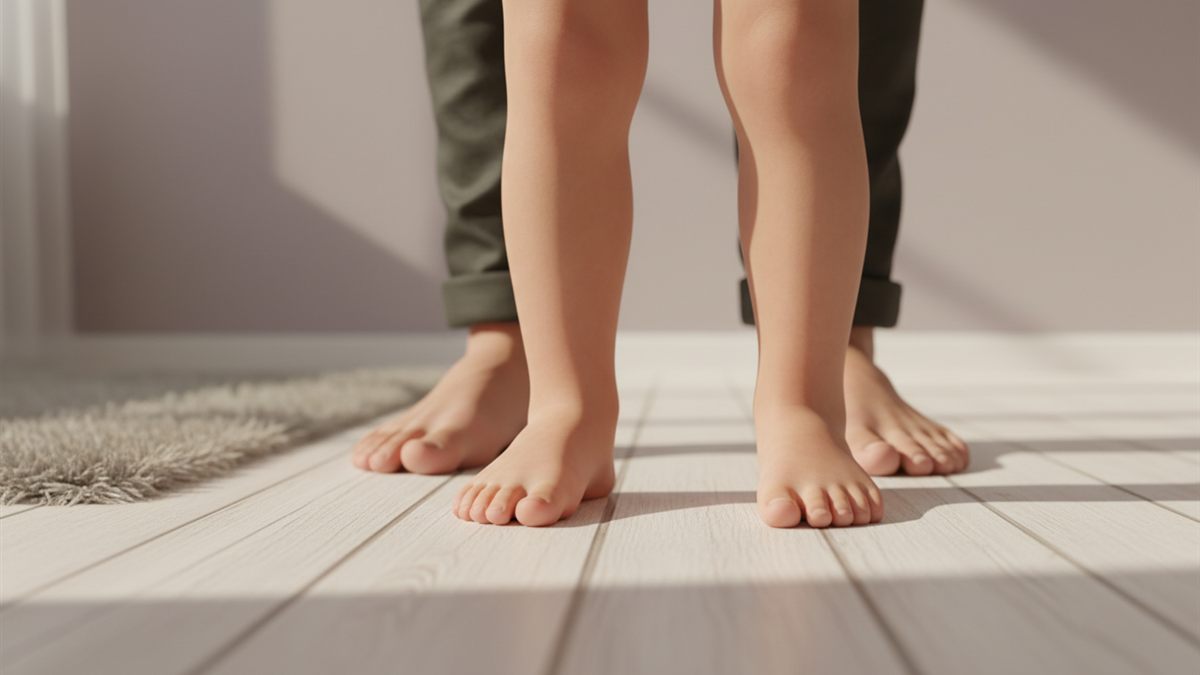
Is it normal for a child to walk on their toes?
Often, yes. Toe walking is common in children who are learning to walk, and after the age of 2 most children stop, according to the American Academy of Orthopaedic Surgeons OrthoInfo. The NHS says the same thing in plainer words: it is common for children aged 3 and under to walk on their toes NHS. A toddler who bounces around on tiptoes, with no other symptoms, is not on its own a warning sign.
When toe walking carries on and no medical cause is found behind it, clinicians call it idiopathic toe walking, which simply means toe walking of unknown cause. It is not rare. NHS paediatric physiotherapy guidance describes it as seen in around 1 in 20 toddlers, and says it usually resolves without treatment between the ages of 5 and 10 Herefordshire and Worcestershire Health and Care NHS Trust. That is the honest starting position for most parents reading this: for the majority of these children the answer is time and review, not a device.
How do I tell harmless toe walking from the kind that needs checking?
Ask your child to stand and walk with their heels flat on the floor. If they can do it easily, if they toe walk on both feet rather than one, and if the rest of their development is on track, the picture is reassuring. The American Academy of Orthopaedic Surgeons notes that many older children who continue to toe walk cannot walk with their heels down OrthoInfo, which makes that the single most useful thing you can check at home.
NHS paediatric physiotherapy advice lists what should prompt a conversation with your doctor: toe walking linked with pain, falling over, or difficulty with physical activities that used to be fine; toe walking on one leg only; a child who cannot get their heels down when asked; and a child for whom getting the heels down makes standing or walking look awkward. Being born prematurely, a delay in speech, or a family history of toe walking also lower the threshold for arranging a proper look Herefordshire and Worcestershire Health and Care NHS Trust. None of these mean something is wrong. They mean that waiting another year to see what happens is not the best plan.
What about bow legs, knock knees and flat feet? Are those normal too?
Mostly yes, and each one has its own normal window. Bowed legs are a normal variation in most children under 2 years old, begin improving at approximately 18 months, and have usually corrected by ages 3 to 4 years OrthoInfo. Knock knees then take over: they peak from two to four years American Family Physician, are common in children aged 3 to 6, and usually correct themselves by the age of 7 NHS.
Flat feet follow the same pattern. Arch development occurs primarily before four years of age American Family Physician, and the NHS notes that flat feet usually correct themselves by the age of 6, with no treatment needed if an arch appears when your child stands on tiptoes. In-toeing, the pigeon-toed walk that worries so many parents, usually corrects itself around the age of 8 and does not normally need treatment NHS. Where it is caused by an inward twist of the shin bone, called internal tibial torsion, it resolves on its own in 90 percent of cases by the time the child reaches eight years of age.
The same clinical review is blunt about devices for that last one: for internal tibial torsion, treatment with night splints, shoe wedges and orthotics is unnecessary and ineffective American Family Physician. We say the same thing in the consulting room. If a child's legs are following the ordinary developmental script, buying off-the-shelf insoles will not speed anything up, and you should expect us to say so rather than sell you something.
Which signs genuinely warrant an assessment?
Asymmetry, pain, a limp, lost skills, and anything getting worse rather than better. Those five things move a child from watch and review into get this looked at. In the clinical literature on children's leg alignment, unilateral deformity, progressive deformity, or lack of spontaneous resolution are the three findings that should raise the possibility of a genuine problem rather than a normal variation American Family Physician.
On knees specifically, the NHS gives parents a clear list of reasons to see a doctor about knock knees: the child is under the age of 2 or over the age of 5; the gap between the ankles is more than 8cm when the knees are together; there is pain, swelling, stiffness or warmth in one or both knees; only one leg is affected, or the legs are different lengths; it is getting worse; the child is very short or underweight for their age; or there is a limp or difficulty walking NHS. For bowed legs the marker is age: if bowing has not gone away by the age of 3 years there may be an underlying cause OrthoInfo, and bowing or knock knees still present beyond seven to eight years of age is a reason for orthopaedic referral American Family Physician.
Take a limp seriously. The Royal Children's Hospital Melbourne lists a duration of more than 7 days, severe localised joint pain, pain waking a child from sleep, inability to walk or weight bear, fever, night sweats or rash, and unexplained weight loss or lethargy as red flags, and states that septic arthritis should be suspected in any child presenting with limp, swelling and reduced range of motion, especially with fever RCH Melbourne. Those children need a doctor urgently, not an orthotist.
The same urgency applies to going backwards. The United States Centers for Disease Control and Prevention tells parents plainly not to wait if a child is not meeting one or more milestones, has lost skills he or she once had, or if there are other concerns CDC. A child who used to walk flat and now cannot, or who was steady and is now falling, is describing a change, and changes get assessed. One last check on feet: a flat foot that stays flat when your child goes up on tiptoes, or one that is stiff and painful, is a different problem from an ordinary flexible flat foot, and stiff or painful flat feet are a recognised reason for orthopaedic referral American Family Physician.
What actually happens at a gait assessment?
Watching, measuring and history taking. Nothing is manufactured or fitted on a first visit. Expect questions about the pregnancy and birth, when your child sat, crawled and walked, speech and school progress, whether anyone else in the family walked on their toes, and whether the pattern is improving, static or getting worse. Then expect a lot of watching your child walk barefoot, from the front, from behind and from the side.
The hands-on part is mostly measurement: how far the ankle bends upwards with the knee straight and then bent, which helps separate a tight calf muscle from a tight Achilles tendon; whether the heel can be brought to the floor both passively and actively; the gap between the knees or between the ankles; leg lengths; hip, knee and foot movement; and the torsional profile, a composite of lower limb measurements used to work out where a rotational problem is actually coming from American Family Physician. Your child will be asked to stand on tiptoes, because an arch that reappears means a flexible flat foot and an arch that does not means something else.
The output is a plan, not a product. Some children leave with an explanation, a home programme and a review date. Some are referred back to the GP or on to a paediatrician, paediatric orthopaedic surgeon or physiotherapist, because the examination raised something that needs a diagnosis before any device is discussed. Only some need a device, and only then does anyone cast or measure. You can see the range of presentations we work with on our conditions page.
What does treatment look like when a child really needs it?
It starts with the least invasive option that has a reasonable chance of working, and escalates only if that fails. For persistent toe walking, the American Academy of Orthopaedic Surgeons states that for children who are 2 to 5 years old and can walk flat-footed, treatment always begins without surgery, using serial casting, bracing and botulinum toxin therapy. In children over age 5 who toe walk, it notes, the calf muscles and Achilles tendons become very tight, and surgical lengthening, followed by casts usually worn for 4 to 6 weeks, enters the conversation OrthoInfo.
Physiotherapy sits underneath all of that. NHS paediatric physiotherapy advice for idiopathic toe walking centres on a home exercise programme built around heels-down stepping, heels-down standing, squatting, bear crawling, and standing and floor stretches to maintain flexibility while the child grows Herefordshire and Worcestershire Health and Care NHS Trust. A few minutes a day of the right exercises does more for most of these children than anything bought off a shelf.
Where a brace is genuinely indicated, an ankle-foot orthosis is the usual device: a moulded support worn inside the shoe that holds the foot and ankle in a corrected position while the calf lengthens. Two practical things are worth knowing before you start. Bracing here is measured in months rather than days, so fit and comfort matter enormously for whether a child actually wears it. And children grow out of them, so a paediatric custom orthosis is a series of reviews and refits rather than a once-off purchase.
Should you book, or should you wait and watch?
Wait and watch if your child is under 2, toe walks on both feet, can put their heels flat when you ask, has no pain and no limp, and is meeting their milestones. Book if any of the red flags apply: one-sided changes, pain, a limp, lost skills, a heel that will not come down, or a pattern that is worsening rather than settling. If you genuinely cannot tell which group your child is in, that uncertainty is a reasonable reason on its own to have them assessed.
Start with your GP or paediatrician if there is pain, a limp, fever or anything that looks neurological, because those need a diagnosis first and an orthotist is not the right first stop. If your child has already been assessed and a brace, insole, splint or orthopaedic footwear has been raised, that is where an orthotist comes in. Farida Cajee-Botes consults at Orthocast Morningside in Sandton by appointment, and offers home and hospital visits across Centurion, Pretoria, Midrand, Sandton and Johannesburg for families who find travelling with a small child difficult. Book an assessment if you would like an opinion on whether your child needs a device or simply needs watching.
This article is general information for South African parents and is not a substitute for individual clinical assessment. The age ranges above describe typical development, and healthy children vary around them; your own child's examination, history and progress over time are what determine whether anything needs doing at all.
Key takeaways
- Toe walking is common in children learning to walk, and most stop after the age of 2. Where it persists without a medical cause, NHS paediatric physiotherapy guidance describes idiopathic toe walking as seen in around 1 in 20 toddlers and usually resolving without treatment between the ages of 5 and 10.
- Each variation has its own normal window: bow legs are normal under 2 and usually corrected by ages 3 to 4; knock knees peak between two and four years and usually correct by age 7; flat feet usually correct by age 6; in-toeing usually corrects by around age 8.
- The signs that genuinely warrant assessment are asymmetry (one leg only), pain, a limp, loss of skills a child once had, a heel that cannot be brought to the floor, and any pattern worsening rather than settling.
- A limp lasting more than 7 days, inability to bear weight, fever, night pain or unexplained weight loss needs a doctor rather than an orthotist. Septic arthritis is an orthopaedic emergency.
- For ordinary in-toeing caused by internal tibial torsion, night splints, shoe wedges and orthotics are described in the clinical literature as unnecessary and ineffective. Most of these children need watching, not devices.
- When treatment is needed it escalates gently: home stretching and physiotherapy first, then serial casting, bracing and botulinum toxin for children aged 2 to 5, with Achilles lengthening surgery generally reserved for older children.
Have a question about your own situation?
Every device we provide starts with an individual assessment: at home, in hospital, or at the practice.
References
- Toe Walking (OrthoInfo, American Academy of Orthopaedic Surgeons)
- Bowed Legs (Blount's Disease) (OrthoInfo, American Academy of Orthopaedic Surgeons)
- Leg and foot problems in children (NHS)
- Knock knees (NHS)
- Lower Extremity Abnormalities in Children (American Family Physician (American Academy of Family Physicians))
- Children's Therapy leaflets: Idiopathic Toe Walking (Herefordshire and Worcestershire Health and Care NHS Trust)
- Clinical Practice Guidelines: The limping or non-weight bearing child (The Royal Children's Hospital Melbourne)
- Milestones by 2 Years (Learn the Signs. Act Early.) (United States Centers for Disease Control and Prevention)