
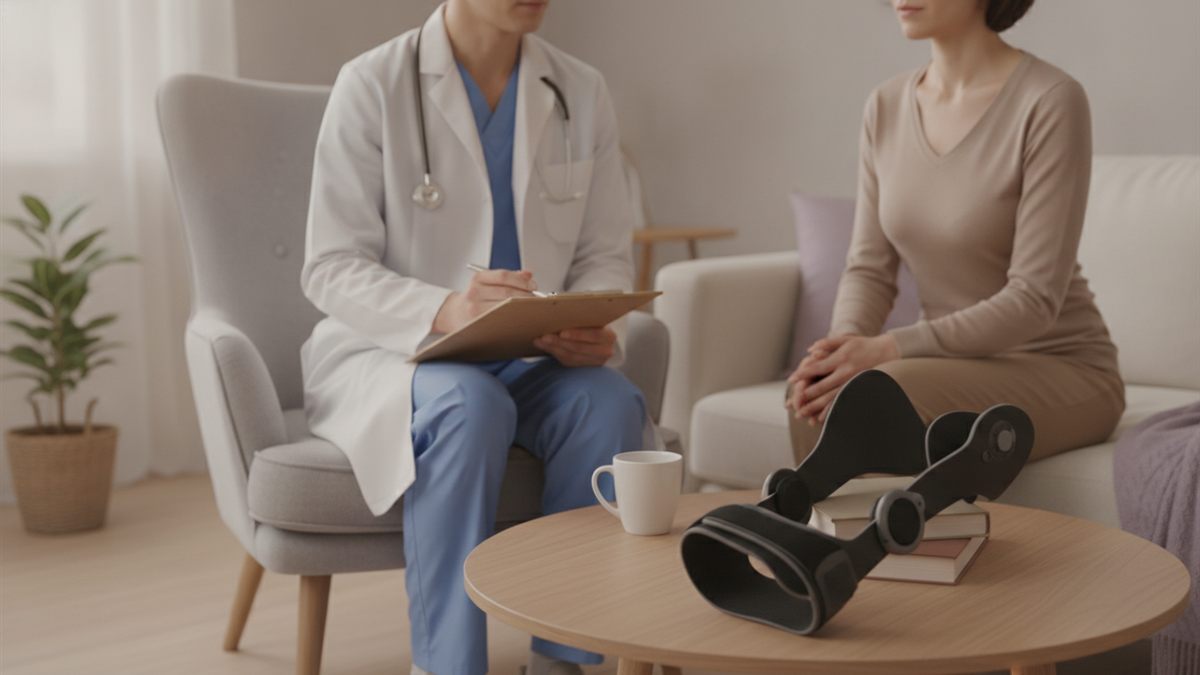
Do orthotists do home visits?
Yes. A home or hospital visit is a full orthotic and prosthetic assessment carried out where you already are: your lounge, your bedroom, or a hospital bed a day before discharge. Almost all of the clinical work travels. History, examination, measuring, plaster casting and most fittings can be done in your own space. What cannot travel is the workshop where custom devices are made.
The barrier is rarely distance. South Africa had 544 prosthetists and orthotists registered with the Health Professions Council of South Africa in 2018, about 0.09 per 10,000 people, and 37.5% of them worked in Gauteng (African Journal of Disability, via PMC), so this province is comparatively well served. The person who needs a device is often the one least able to travel for it: a fresh amputation that hurts to sit on, a wheelchair that will not fit in the car, no driver free on a Tuesday. The World Health Organization's 2023 wheelchair provision guidelines recommend that services be made available as close as possible to where people live (WHO, via NCBI Bookshelf).
Who is a home or hospital visit actually for?
A home visit is for the person whose main obstacle is the journey: people recently operated on or amputated, people recovering from a stroke, frail older adults, patients who are bed-bound or chair-bound, and anyone approaching a hospital discharge date. If you can be driven to Sandton without pain or difficulty, you probably do not need one, and we will say so.
Post-surgical and post-amputation patients are the most common. In the weeks after an amputation the limb is swollen and tender, wounds are still settling, and sitting upright in a car is often the hardest thing anyone does that week. Measuring, limb shaping and planning for a future socket can happen at home while healing carries on, as part of the prosthetics pathway.
After a stroke the usual problem is a drop foot: the foot does not lift clear of the ground during the swing phase of walking. An ankle-foot orthosis, often called a leg brace or caliper, holds it in a safer position. A pooled analysis of stroke studies found that wearing one improved walking speed (standardised mean difference 0.50) and Timed Up and Go times, while body sway did not change (Scientific Reports, via PMC). The brace helps the foot clear the ground; it does not fix balance.
For frail older adults the house itself matters. A 2023 Cochrane review found that home fall-hazard reduction programmes probably reduce the rate of falls by about 26% overall, and by 38% in people already at higher risk, with no evidence of benefit in those not at raised risk (Cochrane). That evidence covers occupational-therapy style hazard programmes, not orthotic visits, so it says nothing about braces. It does show that risk sits in the house, which you cannot see from a consulting room.
Bed-bound and chair-bound patients are the group where skin drives everything. Clinical guidance identifies people who cannot reposition themselves as being at raised risk of pressure sores, and recommends a skin inspection at least once a day with attention to bony prominences (NCBI Bookshelf). Cushions, seating, the edge of a brace and the rim of a socket all belong in that conversation, which is why mobility aids are better set up in the room where they will be used.
What actually happens during a home visit?
The same clinical work that happens in the rooms, plus one thing the rooms cannot offer. Expect a history, an examination, measuring, casting or scanning where a custom device is indicated, and a written quotation to follow. The addition is that your clinician sees the real doorways, the real bed height and the shoes you actually wear.
Your clinician arrives with measuring equipment, casting materials, stock devices to try and the paperwork, takes the medical background, examines the limb (skin, shape, swelling, joint movement, muscle strength), watches you transfer, stand and walk where possible, then measures and casts or scans if a custom device is needed. Anything suitable off the shelf can often be fitted the same day. The WHO wheelchair guidelines make individual assessment and selection a strong recommendation, and specify that fitting should confirm the chair can actually be used at home (WHO, via NCBI Bookshelf). A chair that fits the person but not the passage has not been fitted.
Timing matters for compression garments. Macmillan Cancer Support advises putting a garment on first thing in the morning, when the limb is at its smallest, and notes that one worn daily generally lasts three to six months, with re-measurement before replacements are ordered (Macmillan Cancer Support). That is why we book compression measuring and fitting early in the day. Measure a swollen leg late in the day and the garment will be loose by morning.
What can be done at home, and what genuinely cannot?
Almost all clinical work can be done at home. Almost no fabrication can. Assessment, measuring, plaster casting, scanning, most off-the-shelf fittings, compression fitting, mobility aid set-up, reviews, strap and padding adjustments, skin checks and carer training all travel well. Manufacturing a custom socket or a custom brace does not.
The reason is equipment, not convenience. Conventional socket production runs through hand casting, one or more test sockets and one or more laminated sockets, spread across several appointments (Canadian Prosthetics and Orthotics Journal, via PMC). Thermoformed sockets involve heating plastic in an oven (200 degrees Celsius in one published process) and drawing it over a rectified plaster model under negative pressure (PMC). Ovens, vacuum equipment, grinding and plaster dust are workshop work, and improvising them in a bedroom produces a worse device. So a custom device becomes two home visits instead of two trips out: assessment and casting, fabrication off site, then fitting. The same applies to custom orthotics.
A home visit is also not a video call. In a study of orthotists and prosthetists using telehealth, practitioners reported that triage, education and routine follow-up checks work at a distance, while fitting, alignment and complicated re-assessments kept needing in-person contact; one described a device recommended remotely that had to be changed once the patient was seen face to face (Prosthetics and Orthotics International, via PMC). A phone call between appointments is useful. It is not a substitute for hands on the limb.
How does a hospital visit work with the ward team?
At the bedside the work is organised around the discharge date. The referral usually comes from the treating surgeon, physiotherapist, occupational therapist or hospital case manager, and the aim is that whatever the person needs in order to leave safely (a brace, a compression garment, a walking aid, a wheelchair, or a plan for a future prosthesis) is measured before discharge rather than chased for weeks afterwards.
There is reasonable evidence for that sequencing. A 2022 Cochrane review of 33 trials and 12,242 participants found that a discharge plan tailored to the individual patient probably produces a small reduction in hospital length of stay and slightly fewer readmissions than routine discharge (Cochrane). An Australian trial tested the visit itself: 77 adults recovering from a hip fracture received usual hospital-based occupational therapy either alone or with a single home assessment visit before discharge, and the home-visit group had fewer readmissions at 30 days and six months (Clinical Rehabilitation, via PMC). It is small, and it studied occupational therapy rather than orthotics, so treat it as supportive context rather than proof.
Practically, we work around ward rounds and therapy sessions, write findings into the file or send a report to the treating team, and start the funding paperwork while the patient is still admitted, because scheme authorisation is usually the slowest step. Our article on what medical aid covers for prosthetics and orthotics explains how appliance benefits, Prescribed Minimum Benefits and co-payments work.
What does the family need to arrange?
Very little. A firm chair or the bed, enough floor space to kneel beside a leg, a clear stretch of passage to walk down, and decent light. If casting is planned, an old sheet or towels and a basin of water, because plaster drips. There is no need to tidy up on our account: the clutter, the loose rug and the awkward step are part of the assessment.
A first assessment takes noticeably longer than a follow-up review, because it includes the history, examination, measuring and the funding discussion, and casting adds time because plaster has to set. We give a realistic estimate when booking, so lifts, carers and transport can be arranged around it.
Whoever helps the patient day to day should be in the room rather than the kitchen. If a spouse, an adult child or a carer will be pulling on a compression stocking, donning a prosthesis or tightening a brace, they need to learn it with their hands on the device. The WHO wheelchair guidelines list instructing others to assist as one of four priority areas that user training must cover (WHO, via NCBI Bookshelf).
Have ready your ID and medical aid card, any referral or prescription, the discharge summary or operation notes, a list of current medicines, any existing braces, prostheses or stockings, and the shoes worn every day rather than the good pair kept for church. Mention any red or broken skin when you book, so the right padding and offloading options come along.
Where do you visit, and when is a clinic appointment better?
Farida Cajee-Botes consults from Orthocast Morningside in Sandton by appointment, and travels for home and hospital visits across Centurion, Pretoria, Midrand, Sandton and Johannesburg. There are no consulting rooms in Centurion; care there is a mobile visit to your home, a hospital ward or a care facility.
A consulting room appointment is often the better choice, and it is worth saying so rather than selling a visit nobody needs. There is more stock to try on, and prosthetic alignment work is faster where the bench and tools already are. A home or hospital visit earns its place when travel is genuinely the obstacle, when the device has to be judged against a real staircase or bathroom door, or when a discharge date is coming and the equipment has to be there before it arrives.
If you are unsure which applies, describe the situation and you will get a straight answer, including if that answer is that you do not need us yet. Have a look at the conditions we commonly manage, then book an assessment and we will confirm whether a home visit, a hospital visit or a rooms appointment makes more sense, and what your medical scheme will need from us.
This article is general information for South African patients and is not a substitute for individual clinical assessment.
Key takeaways
- Yes, orthotists and prosthetists do home and hospital visits. Assessment, measuring, plaster casting, most off-the-shelf fittings, reviews and small adjustments can all be done where you are.
- What cannot be done at home is fabrication. Custom sockets and braces need workshop ovens, vacuum equipment and grinding, so a custom device usually means two home visits with the making done off site in between.
- Home and hospital visits suit people recovering from surgery or amputation, people after a stroke, frail older adults, bed-bound or chair-bound patients, and anyone approaching a hospital discharge date.
- Families need to arrange almost nothing: a firm chair or bed, a clear stretch of floor, good light, and whoever helps day to day present so they can be taught with their hands on the device.
- If travel is comfortable, a consulting room appointment is usually better, because more stock and equipment are on hand. A home visit is for when travel, or the home itself, is the real issue.
Have a question about your own situation?
Every device we provide starts with an individual assessment: at home, in hospital, or at the practice.
References
- Exploring national human resource profile and trends of Prosthetists/Orthotists in South Africa from 2002 to 2018 (African Journal of Disability (PMC))
- Wheelchair provision guidelines: recommendations and implementation guidance (World Health Organization (NCBI Bookshelf))
- Effectiveness of an ankle-foot orthosis on walking in patients with stroke: a systematic review and meta-analysis (Scientific Reports (PMC))
- Environmental interventions for preventing falls in older people living in the community (Cochrane Database of Systematic Reviews)
- Pressure Ulcers in Adults: Prediction and Prevention (clinical practice guideline) (AHCPR (NCBI Bookshelf))
- Compression treatment for lymphoedema (Macmillan Cancer Support)
- Transfemoral Socket Fabrication Method Using Direct Casting: Outcomes Regarding Patient Satisfaction with Device and Services (Canadian Prosthetics and Orthotics Journal (PMC))
- Assessing PET composite prosthetic solutions: A step towards inclusive healthcare (PMC (National Library of Medicine))
- Exploration of the barriers and facilitators influencing use of telehealth for orthotic/prosthetic services in the United States of America (Prosthetics and Orthotics International (PMC))
- Discharge planning from hospital (Cochrane Database of Systematic Reviews)
- An economic evaluation of pre-discharge home assessment visits following hip fracture: analysis from a randomised controlled trial (Clinical Rehabilitation (PMC))