
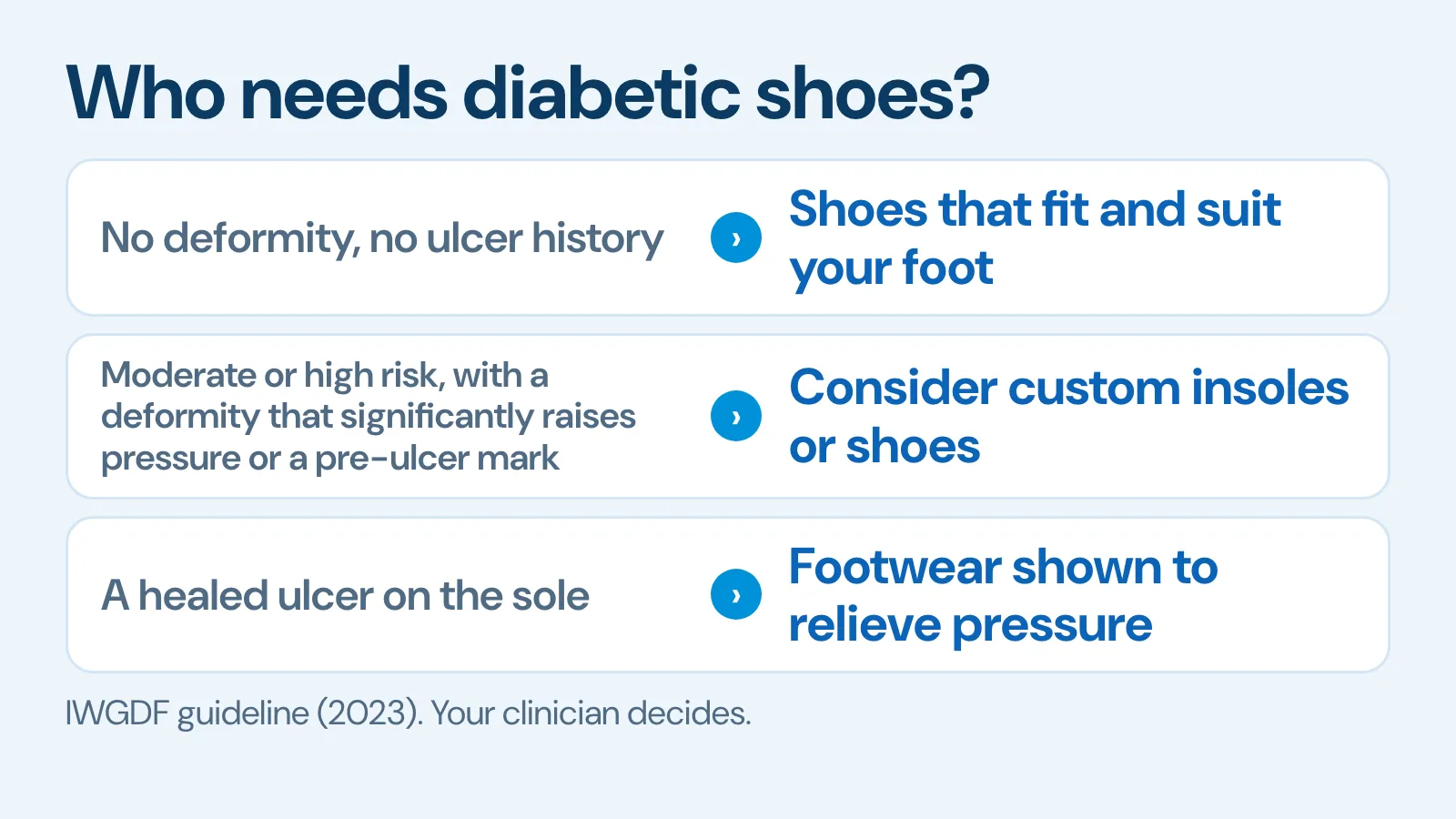
Probably not, if you still have normal feeling in your feet, the circulation to them is good and you've never had a foot ulcer. If that's you, the advice is shoes that fit well, a look at your feet every day and regular foot checks with your doctor, nurse or podiatrist.
That can change if you've lost feeling in your feet or your circulation is poor, and more so if the shape of your foot has changed or you've had an ulcer before. Then your shoes and insoles become part of protecting your feet, and some people need them made for their feet.
This is general information, not a diagnosis. If you have a new wound, or a foot that's red, hot or swollen, don't read on: contact your doctor straight away.
Why diabetes changes what you put on your feet
High blood sugar can damage the small blood vessels that supply the nerves in your feet. When those nerves are damaged you can lose feeling, so you may not notice a stone in your shoe or a blister starting. Damaged blood vessels also reduce the blood supply to your feet, which can slow the healing of cuts and sores.
So a shoe that rubs matters more than it used to. Someone with normal feeling takes off a shoe that hurts. Someone who has lost feeling can walk on a blister all day. The International Working Group on the Diabetic Foot (IWGDF), in its 2023 guideline on preventing foot ulcers, says people who've lost feeling may not be able to judge whether a shoe fits, and that shoes that are too short or too narrow increase the risk of an ulcer.
Your risk group decides the advice
The IWGDF guideline sorts people with diabetes by their risk of a foot ulcer. It starts from whether you've lost protective feeling in your feet and whether you have peripheral artery disease, which means poor circulation to the legs.
Very low risk: normal feeling and normal circulation.
Low risk: lost feeling or poor circulation.
Moderate risk: lost feeling and poor circulation together, or either of them with a foot deformity, a hammertoe for example.
High risk: lost feeling or poor circulation, plus a past foot ulcer, a lower-limb amputation or end-stage kidney disease.
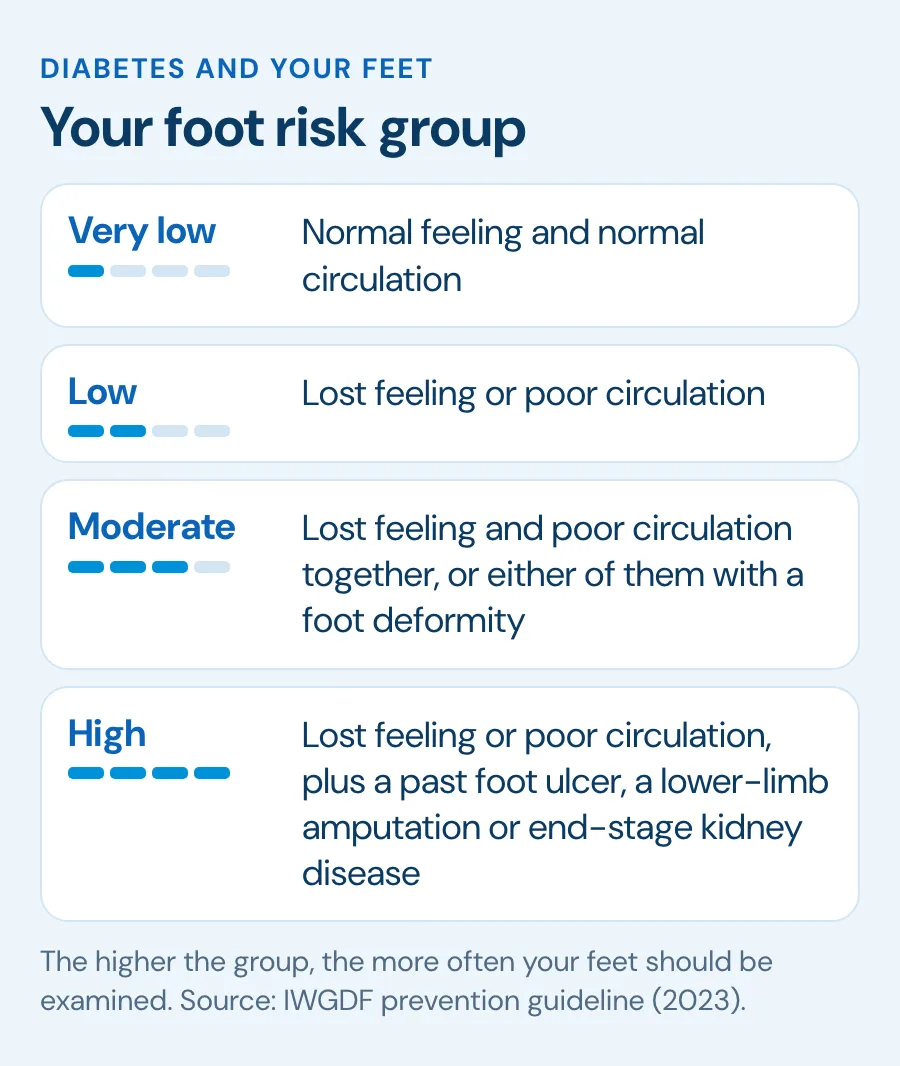
The higher the group, the more often your feet should be examined. Your doctor, diabetes nurse or podiatrist can tell you which group you're in.
What the guideline says about shoes and insoles
If you're at risk but your foot has little or no deformity, no pre-ulcer marks and no history of an ulcer on the sole, the advice is footwear that fits properly and suits the shape of your feet.
If you're at moderate or high risk and a deformity significantly raises the pressure under part of your foot or you have a pre-ulcer mark such as a blister or a crack in the skin, the guideline says to consider extra-depth shoes, custom-made shoes, custom-made insoles or toe orthoses. A new blister is also among the signs that need help today, further down.
If you're at risk and you've had an ulcer on the sole of your foot that has healed, it recommends footwear shown to relieve the pressure under your foot while you walk, worn all the time, indoors and outdoors, to help stop the ulcer coming back.
How much difference does it make? The guideline is honest about its evidence: it rates the certainty as low for most of this advice and moderate for the healed-ulcer advice. It also says that therapeutic shoes and insoles can lower the pressure under the foot while you walk, and that high pressure under the foot is a risk factor for ulcers in its own right.
What about the diabetic insoles at the pharmacy?
Pharmacies sell insoles labelled for diabetics. If you're at risk but your feet keep their shape, the guideline's advice is about the shoe rather than the insole: a shoe that fits. If you're at moderate or high risk with a deformity that significantly raises pressure or a pre-ulcer mark, the insoles it names are custom-made ones, shaped to your foot so they can take pressure off the area at risk.
Whatever you use has to fit the shoe as well as the foot. The guideline asks for shoes with enough length, width and depth, and an insole takes up room inside the shoe. Old insoles and old shoe linings can cause problems too. For a wider look at shop insoles versus custom ones, see whether custom orthotics are worth it.
Choosing shoes when you have diabetes
Look for shoes that are wide-fitting, with a deep, rounded toe area, flat or low-heeled, and fastened with a lace or buckle so your foot doesn't slide around. Wear new shoes around the house for a short time first, to check they don't rub.
Have them fitted standing up, preferably at the end of the day. Check inside your shoes every time before you put them on, for a stone or anything sharp that's come through the sole.
If you're at low, moderate or high risk, don't walk barefoot, in socks without shoes or in thin-soled slippers, indoors or outdoors. For socks, the guideline suggests natural fibres, without seams, preferably light-coloured, so a mark from a sore shows up.
Look at your feet every day
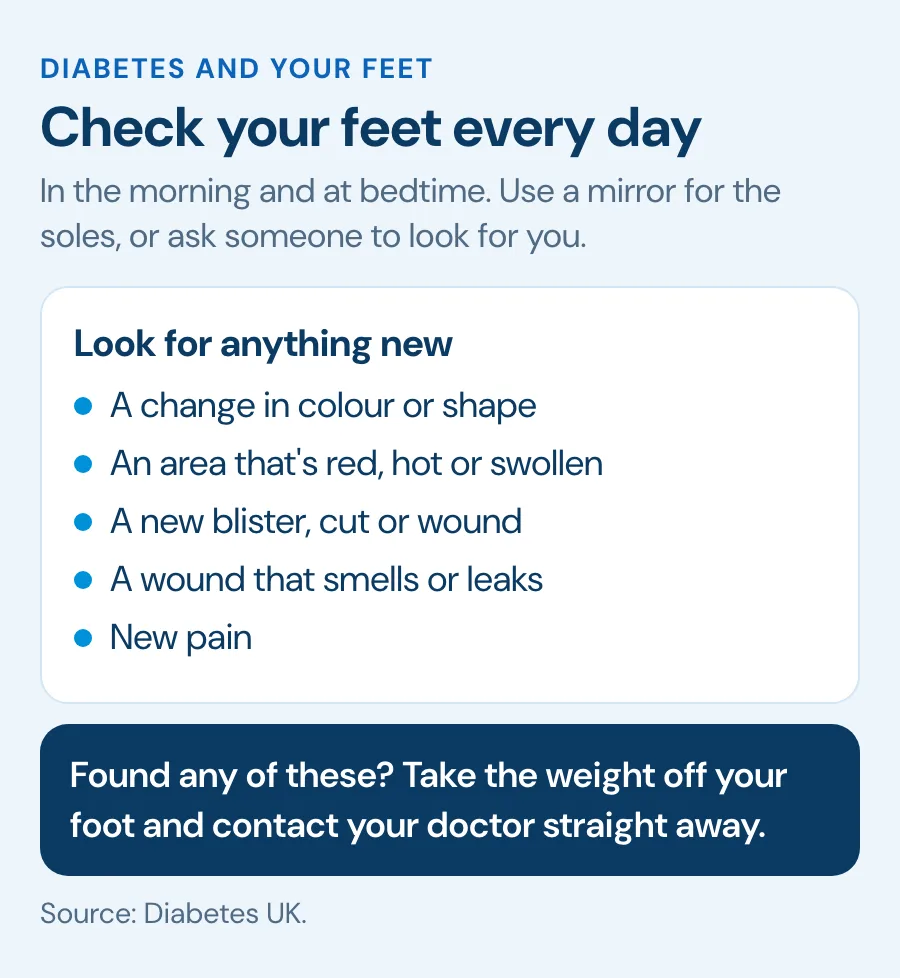
Look at your feet before you put your socks on in the morning and before you go to bed. If you can't lift your feet to see the soles, use a mirror while you're sitting or lying down, or ask someone to look for you.
You're looking for anything new: a change in colour or shape, an area that's red, hot or swollen, a blister, cut or wound, especially if you can see it but don't feel it, and new pain.
Signs that need help today
Diabetes UK says to get help urgently if you notice any of these:
A change in the colour or shape of all or part of your foot, especially a red, hot, swollen toe, ankle or foot.
Part or all of your foot feeling much colder or hotter than usual.
A new blister, cut or wound, especially if you can see it but can't feel it.
A cut or wound that smells bad or is leaking fluid or pus.
New or unexplained pain in your foot.
Sit or lie down and take the weight off your foot, then contact your doctor or the clinic that manages your diabetes straight away. If they aren't available, go to an after-hours clinic or emergency unit. A blister can quickly become infected when you have diabetes, so don't wait to see if it settles.
How I help
I'm an orthotist, so my part is insoles and how they work with your shoes. Every insole I provide is custom-made after an assessment, moulded from a cast, a foam impression or a scan of your foot to help spread the pressure under it. I don't stock shop insoles. The assessment looks at your feet, how you walk and the shoes the insoles will go into.
A wound, hard skin and nails are for your doctor or a podiatrist, and a wound needs their care first. If you've been told your feet are at moderate or high risk, or your doctor has suggested custom insoles, see my custom orthotics service and book an assessment. I see patients at the Orthocast Morningside rooms in Sandton, and at home or in hospital if getting out is hard.
Key takeaways
- If you have normal feeling in your feet, good circulation and no history of an ulcer, you probably don't need special shoes: shoes that fit, a daily look at your feet and regular foot checks.
- Lost feeling, poor circulation, a change in foot shape or a past ulcer raise your risk. At moderate or high risk, with a deformity that significantly raises pressure or a pre-ulcer mark, the guideline says to consider extra-depth or custom-made shoes and custom insoles.
- After an ulcer on the sole has healed, the guideline advises footwear shown to relieve pressure, worn indoors and outdoors.
- A red, hot or swollen foot, a new wound or a change in shape needs help urgently: contact your doctor straight away.
Have a question about your own situation?
Every device we provide starts with an individual assessment: at home, in hospital, or at the practice.
References
- IWGDF Prevention Guideline (2023 update) (International Working Group on the Diabetic Foot)
- Diabetes and foot problems (Diabetes UK)
- How to look after your feet (Diabetes UK)
- Signs of serious foot problems and foot infections (Diabetes UK)