
The short answer
Yes - most people who lose a leg can learn to walk again, and many develop a gait that looks smooth and natural to a casual observer. But "normal" is relative: your walking pattern, speed, endurance and need for a stick or rest breaks depend on your amputation level, general health, residual limb condition, and how consistently you do the rehab work. Cleveland Clinic notes that with the right prosthesis and training, people go on to walk, run marathons, ski or take part in the Paralympics - but it also stresses that the full process, including physical and psychological adjustment, "can take up to a year" Cleveland Clinic. Hanger Clinic describes a similarly gradual process: expect consistent, steady practice over a period of months to regain the strength and confidence to use your prosthesis comfortably in daily life, and the process generally takes longer if you have an above-knee or bilateral amputation Hanger Clinic.
What shapes your walking pattern: amputation level and K-level
Two things drive expectations more than anything else: where the amputation is, and your functional (K) level. A below-knee (transtibial) amputation preserves your own knee joint, so gait tends to be more energy-efficient and easier to relearn than an above-knee (transfemoral) amputation, where the prosthetic knee must be controlled as well as the foot. Bilateral amputees generally need more time and more upper-body or parallel-bar support early on Hanger Clinic; Cleveland Clinic.
K-levels (K0 to K4) are the classification system your prosthetist and medical scheme use to match components to your realistic mobility goals. K1 describes limited household walking on flat, predictable surfaces, often with support for sitting and standing. K2 adds limited outdoor and community mobility on flat, predictable surfaces, managing one or two stairs or an ADA-style ramp, plus light activities such as grocery shopping. K3 is the typical "community ambulator" who can vary pace, multitask while walking and manage most environmental barriers, including several consecutive stairs and varied terrain. K4 covers high-demand activity such as running or sport Ottobock. Your K-level isn't fixed forever - it's reassessed as your strength, balance and confidence change, and it directly determines whether a basic foot or a microprocessor knee is appropriate and fundable.
What the rehab and physio process actually involves
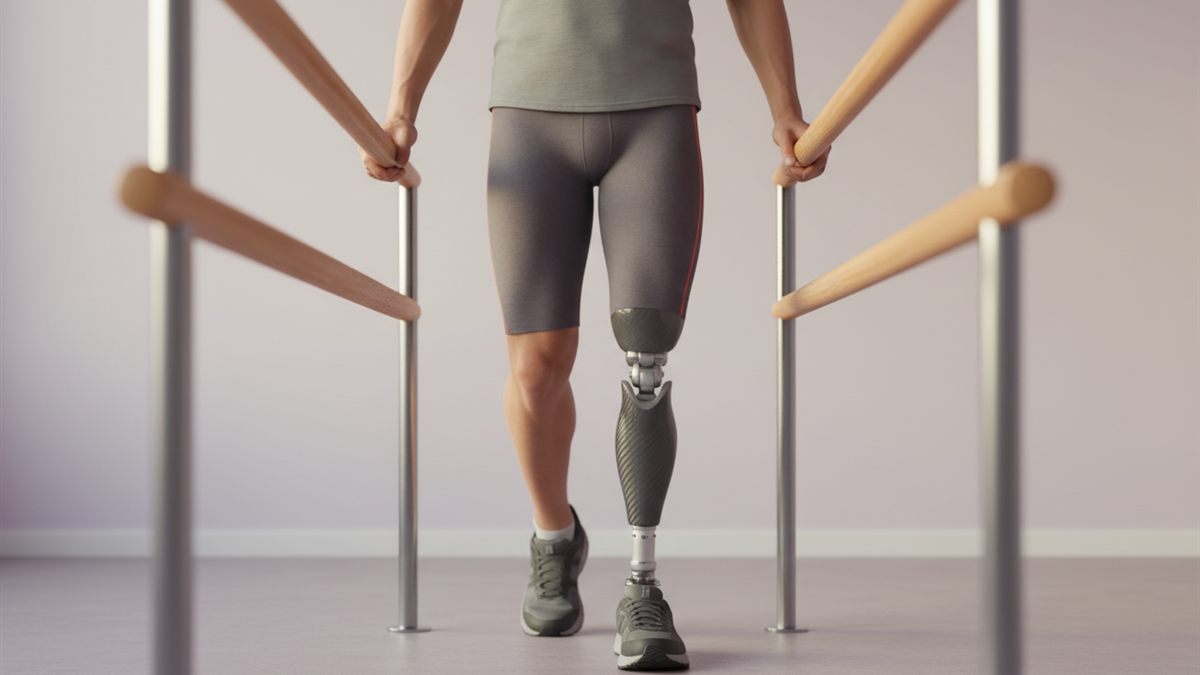
Training typically begins well before your first prosthesis is even fitted. Cleveland Clinic describes an average gap of three to six months between amputation and the start of formal prosthetic training, used for wound healing, limb shaping and building general strength Cleveland Clinic. Once fitted, Hanger Clinic outlines a fairly consistent progression: learning to don and doff the socket safely; standing and shifting weight onto the prosthetic side; walking in parallel bars with both hands supported, then one hand, then no hands; and finally practising real-world tasks such as stairs, curbs, uneven ground and getting in and out of a car Hanger Clinic.
This is where a physiotherapist and prosthetist working as a team matters most - the prosthetist fits and adjusts the socket and alignment, while the physiotherapist builds the strength, balance and gait mechanics that make the device usable. Locally, we work alongside physiotherapy practices and rehabilitation units across Gauteng, coordinating socket adjustments with your therapy sessions so you're not troubleshooting fit issues and relearning gait patterns in isolation from one another. If you're newly referred, ask your surgeon or GP for a physio contact early - starting joint mobility and core work before your first fitting shortens the road afterwards. You can read more about our prosthetics service and related conditions we support.
Realistic timeframes
Putting the above together: expect basic parallel-bar walking within the first few weeks of your first prosthesis, independent walking on flat ground within one to a few months, and confident handling of stairs, uneven terrain and a full day on your feet somewhere between three months and a year, depending on amputation level, age, other health conditions and how much practice you put in outside of appointments Cleveland Clinic; Hanger Clinic. These are general patterns, not promises - your prosthetist and physiotherapist will set goals based on your own assessment.
Standing all day, stairs, and driving
Standing all day: it's achievable for many K2-K3+ users once fitted and conditioned, but your residual limb still swells and shrinks throughout the day. Expect to adjust sock ply or liner thickness, take short seated breaks if swelling occurs, and keep the skin clean and dry to avoid pressure sores - your prosthetist can also advise on liners or suspension changes for long standing shifts.
Stairs: this is trained explicitly during rehab. Ottobock's K-level framework notes that community-level (K3) users are generally able to climb three to seven consecutive stairs and manage varied terrain, while K2 users may be able to manage only one or two stairs (or use a ramp instead), and K1 users typically rely on support for sitting, standing and transfers rather than free stair climbing Ottobock.
Driving: many amputees return to driving, often within a few months, sometimes with an automatic transmission or pedal modifications depending on which side is affected - a peer-reviewed study in Archives of Physical Medicine and Rehabilitation found that over 80% of participants returned to driving at an average of under four months after amputation, with right-sided amputees significantly more likely to need vehicle modifications or a switch to left-foot pedal use Archives of Physical Medicine and Rehabilitation, via PubMed. In South Africa you're legally required to declare any medical condition affecting driving to the licensing authority, and your doctor or prosthetist can advise on any restriction or modification needed.
South African funding and rehab pathways
Cost is rarely a single number - it depends on socket design and labour, the components prescribed (a basic foot versus a microprocessor knee, for example), and recurring costs such as component wear and periodic socket adjustments as your limb changes shape over time Össur South Africa. Rather than quote a fixed price, we recommend requesting a written, itemised quotation once your assessment and prescription are complete.
Funding in South Africa generally comes from one of three routes: your medical scheme's external medical device or prosthetic benefit; the Road Accident Fund if the amputation followed a motor vehicle incident; or the Compensation for Occupational Injuries and Diseases Act (COIDA) fund for workplace injuries SAOPA. If your scheme's standard benefit is insufficient, ask about Prescribed Minimum Benefits (PMB) - amputation is one of the roughly 270 conditions covered under PMB regulations, so related prosthetic provision may be fundable under PMB depending on your scheme's rules, though the process varies by scheme and typically needs supporting motivation from your treating team SAOPA; Össur South Africa. We can help prepare quotations and clinical motivations for scheme, PMB, RAF or COIDA submissions as part of your assessment.
When to see an orthotist or prosthetist
If you're newly referred for amputation, already using a prosthesis but struggling with fit, pain, stairs or standing tolerance, or simply want an honest opinion on what a realistic walking goal looks like for you, an in-person assessment is the best next step. Farida Cajee-Botes offers home and hospital visits across Centurion and the greater Gauteng area alongside clinic appointments, so early rehab conversations can happen wherever is easiest for you.
This article is general information for a South African audience and is not a substitute for individual clinical assessment - your own prognosis depends on factors specific to you. To discuss your situation with a HPCSA-registered prosthetist, book an assessment.
Key takeaways
- Many amputees achieve a smooth, natural-looking gait, but the timeline and end result depend heavily on amputation level, general health and how consistently rehab is done.
- Below-knee (transtibial) amputees typically progress faster than above-knee (transfemoral) or bilateral amputees, who rely on more hip and core strength.
- Formal gait training runs for weeks, but building the strength, stamina and confidence for full daily life can take several months to about a year.
- K-levels (K0-K4) describe expected walking ability and guide which prosthetic components - foot, knee, suspension - are appropriate for you.
- In South Africa, funding runs through medical scheme benefits, Prescribed Minimum Benefits, the Road Accident Fund or COIDA, alongside a physiotherapist-prosthetist rehab partnership.
Have a question about your own situation?
Every device we provide starts with an individual assessment: at home, in hospital, or at the practice.
References
- Learning to Walk with a Prosthetic Leg (Hanger Clinic)
- Prosthetic Leg: What It Is, Who Needs It & How It's Used (Cleveland Clinic)
- Amputee Mobility Levels (Ottobock)
- Financial Considerations (Össur South Africa)
- Reimbursement (South African Orthotic and Prosthetic Association (SAOPA))
- Return to Driving After Lower-Extremity Amputation (Archives of Physical Medicine and Rehabilitation (via PubMed))